

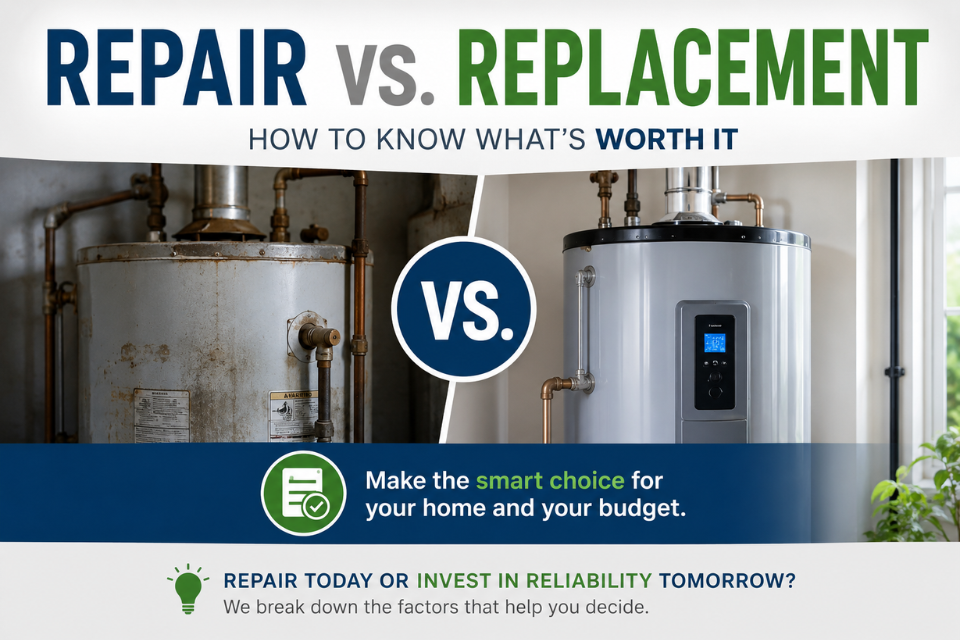
When something in your home stops working—your water heater, boiler, furnace, or major plumbing fixture—the first question is usually: Can this be repaired, or do I need to replace it?
A repair often feels like the quickest and cheapest solution, but it’s not always the smartest long-term decision. In many cases, replacement ends up saving money, improving safety, and preventing repeated breakdowns.
Here’s how to think through the decision clearly.
1. The Age of the System Matters More Than the Problem
Most plumbing and heating systems have a predictable lifespan:
- Water heaters: ~8–12 years
- Boilers: ~15–25 years
- Furnaces: ~15–20 years
- Major plumbing fixtures: varies widely
If your system is already near or past its expected lifespan, repairs often become temporary fixes rather than real solutions.
A key question to ask:
“If I repair this today, will something else fail within the next year?”
If the answer is likely yes, replacement becomes the more practical option.
2. Repeated Repairs Are a Red Flag
One repair is normal. Two is common. But a pattern of breakdowns usually signals a system in decline.
Signs you’re in the “repair cycle”:
- You’ve called for service more than once in the last 12–18 months
- New issues keep appearing after each fix
- Parts are becoming harder to find
- Performance keeps declining even after repairs
At that point, you’re often spending money to “hold together” a system that is already failing.
3. Efficiency and Energy Costs Are Often Overlooked
Older systems don’t just break more often—they usually cost more to run.
For example:
- Older water heaters lose efficiency due to sediment buildup
- Aging boilers and furnaces burn more fuel for less heat
- Outdated systems may struggle to maintain consistent temperatures
Even if a repair is possible, the ongoing utility costs can quietly outweigh the repair savings over time.
4. Safety Risks Increase With Age
As systems age, safety becomes a bigger concern than convenience.
Potential risks include:
- Corrosion leading to leaks or water damage
- Cracked heat exchangers in heating equipment
- Carbon monoxide risks in older combustion systems
- Pressure tank or valve failures
If there is any concern about safety, replacement is often the responsible choice—not just the economical one.
5. When Repair Still Makes Sense
Repair can still be the right decision when:
- The system is relatively new
- The issue is isolated (like a single part failure)
- The cost of repair is low compared to replacement
- The system has been reliable overall
A good technician should always be able to explain whether the repair is a “real fix” or just a temporary extension of time.
6. The Replacement Advantage: What Homeowners Gain
Replacing an older system isn’t just about avoiding breakdowns. It often provides:
- More consistent performance
- Lower energy usage
- Fewer emergency service calls
- Improved safety and reliability
- Peace of mind during peak seasons (winter, holidays, etc.)
In many homes, replacement shifts maintenance from reactive to proactive—which is a major quality-of-life improvement.
7. A Simple Rule of Thumb
If you’re unsure, this rule helps:
If repair costs + expected future repairs approach the value of a new system, replacement is usually the better investment.
It’s not just about today’s fix—it’s about what your home will need over the next several years.
Final Thoughts
Every home system reaches a point where repairs stop being the best option. The challenge is recognizing it before you spend more money on repeated fixes.
A trusted professional can help you evaluate your system honestly and walk you through both options without pressure.
If you’re unsure whether to repair or replace your water heater, boiler, or plumbing system, the team at Applause Plumbing and Heating helps homeowners throughout the Lehigh Valley, including Easton, Bethlehem, Nazareth, and surrounding areas make the right long-term decision for their home.