

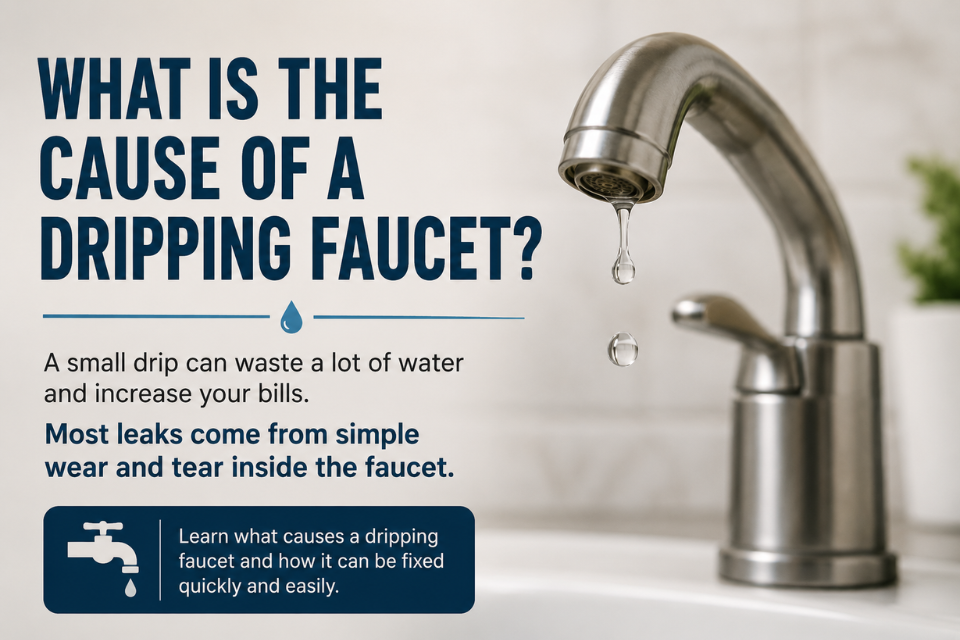
A dripping faucet might seem like a small annoyance, but over time it can lead to higher water bills, wasted water, and even damage to your sink or countertop. That steady drip… drip… drip… usually points to a simple internal problem inside the faucet itself rather than anything wrong with your plumbing system.
The good news is that most faucet leaks come from a few common, inexpensive parts that wear out over time.
The Most Common Cause: Worn-Out Washers
Inside many traditional faucets is a small rubber washer that helps create a tight seal when you turn the handle off. Every time you use the faucet, that washer gets pressed against a metal surface.
Over time, that constant pressure and friction causes the washer to:
- Flatten
- Crack
- Harden
- Lose its ability to seal properly
Once the washer is damaged, water begins to slowly slip through even when the faucet is turned off completely. That’s when you notice the dripping.
This is one of the most common causes of leaks in older compression-style faucets.
Another Frequent Culprit: A Bad O-Ring
Modern faucets often use small rubber O-rings instead of (or in addition to) washers. These O-rings are tiny circular rubber seals located inside the faucet handle or stem assembly.
When an O-ring wears out, it can cause dripping in a couple of ways:
- Water leaks around the handle
- Water drips from the spout even when turned off
- The handle itself may feel loose or wobbly
Just like washers, O-rings degrade naturally over time due to:
- Regular use
- Water pressure
- Hard water mineral buildup
Replacing an O-ring is usually a quick and inexpensive fix.
Cartridge Problems in Modern Faucets
Many newer faucets don’t use washers or O-rings alone—they rely on a cartridge system that controls both water flow and temperature.
When a cartridge begins to fail, you may notice:
- A constant drip from the faucet spout
- Difficulty turning water fully off
- Uneven water temperature control
Cartridges wear out due to sediment buildup, mineral deposits, or simple age. In most cases, replacing the cartridge restores the faucet to like-new condition.
Hard Water and Mineral Buildup
In areas with hard water, mineral deposits can slowly build up inside the faucet over time. This buildup can:
- Prevent washers or cartridges from sealing properly
- Cause stiffness in moving parts
- Accelerate wear on rubber components
Even if the internal parts are not fully damaged, mineral scaling alone can sometimes cause a persistent drip.
High Water Pressure Can Make It Worse
Excess water pressure doesn’t always cause a faucet to drip directly, but it can speed up wear on internal components. Over time, that added stress weakens seals and shortens the lifespan of washers, O-rings, and cartridges.
If multiple fixtures in your home are dripping or wearing out quickly, water pressure may be part of the issue.
Why a Small Drip Shouldn’t Be Ignored
A faucet that drips once per second can waste hundreds of gallons of water per year. Beyond the utility cost, constant moisture can also:
- Stain sinks and fixtures
- Encourage mold or mildew growth
- Increase wear on plumbing components
What starts as a minor annoyance can quietly become a bigger issue over time.
Can You Fix a Dripping Faucet Yourself?
In many cases, yes. If the issue is a washer or O-ring, a basic DIY repair may solve the problem with a few tools and a replacement part.
However, faucet repairs can become complicated when:
- Parts are corroded or stuck
- Cartridge systems are involved
- The faucet model is older or discontinued
- Multiple leaks are present
When to Call a Plumber
If the faucet continues dripping after basic repairs—or if you’re unsure which internal component is failing—it may be time for professional help.
A licensed plumber can quickly identify the exact cause and determine whether repair or replacement is the best option.
For homeowners in New Jersey and Pennsylvania, Applause Plumbing and Heating regularly handles faucet repairs, cartridge replacements, and fixture troubleshooting to stop leaks at the source and restore proper function.
Final Thoughts
Most dripping faucets come down to simple wear-and-tear inside the fixture—usually a washer, O-ring, or cartridge that no longer seals properly. While the fix is often straightforward, ignoring the problem can lead to wasted water and higher bills over time.
If your faucet is dripping and you’re not sure where to start, getting it inspected early can save both water and frustration.