

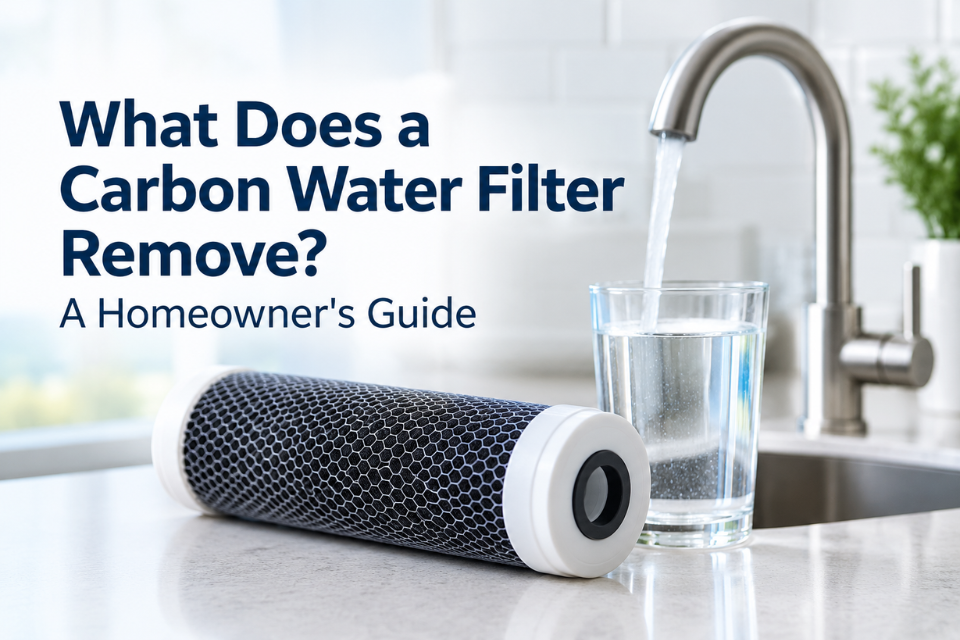
If you've ever noticed a chlorine smell in your tap water, an unusual taste, or an odor that seems to come and go, you may have wondered whether a water filter could help.
One of the most common types of water filtration is activated carbon filtration. Carbon filters are widely used in residential water treatment because they can reduce a number of substances that affect the taste, odor, and overall quality of household water.
But what exactly does a carbon filter remove—and what doesn't it remove?
Understanding how activated carbon works can help you determine whether a carbon water filter is the right choice for your home.
What Is an Activated Carbon Water Filter?
Activated carbon is a form of carbon that has been processed to create an extremely large number of tiny pores throughout the material. These pores give activated carbon a very large surface area.
When water passes through the carbon, certain dissolved substances are attracted to and held on the surface of the carbon. This process is called adsorption.
Adsorption is different from absorption.
- Absorption occurs when a substance is taken into the interior of another material, similar to a sponge soaking up water.
- Adsorption occurs when molecules adhere to the surface of a material.
Activated carbon is particularly effective at adsorbing many organic compounds and substances responsible for unpleasant tastes and odors.
What Does a Carbon Water Filter Remove?
The exact performance of a carbon filter depends on the type and quality of the carbon, the design of the filtration system, the water chemistry, flow rate, and the specific contaminants present.
However, carbon filtration is commonly used to reduce:
1. Chlorine
One of the most common reasons homeowners install a carbon filter is to reduce chlorine in municipal water.
Chlorine is intentionally added to public water supplies as a disinfectant. It plays an important role in protecting drinking water from harmful microorganisms as water travels through the distribution system.
However, some people don't like the taste or smell of chlorinated water.
Activated carbon can react with and adsorb chlorine compounds, reducing the chlorine that reaches your home's faucets.
2. Taste and Odor
Carbon filtration can significantly improve the taste and smell of water when those characteristics are caused by substances that activated carbon can adsorb.
For example, carbon filtration may help reduce:
- Chlorine taste and odor
- Certain organic compounds
- Musty or earthy odors
- Some unpleasant tastes associated with organic contaminants
This is one reason carbon filters are commonly used for drinking water.
3. Certain Organic Compounds
Activated carbon is particularly useful for reducing many organic compounds.
Depending on the specific carbon and filtration system, carbon may reduce certain compounds associated with:
- Fuels and solvents
- Industrial chemicals
- Some pesticides
- Some volatile organic compounds (VOCs)
However, it is important not to assume that a carbon filter removes every chemical simply because it is a "water filter."
Different contaminants behave differently in water, and different carbon products have different capabilities.
4. Some Disinfection Byproducts
When chlorine reacts with naturally occurring organic matter in water, it can form compounds known as disinfection byproducts.
Certain activated carbon systems can reduce some of these compounds.
The effectiveness depends on the specific contaminant, carbon media, contact time, and filtration system.
What Doesn't a Carbon Filter Remove?
This is one of the most important things homeowners should understand.
A carbon filter is not a universal water purifier.
Carbon filtration is excellent for certain contaminants, but other water-quality problems require different treatment methods.
Hard Water Minerals
Carbon filters generally do not remove the calcium and magnesium responsible for hard water.
If you're experiencing:
- White scale on faucets
- Mineral deposits on showerheads
- Spotting on dishes
- Soap that doesn't lather well
- Scale buildup inside plumbing
you may have a hard water problem.
A water softener works differently from a carbon filter and is designed to reduce the calcium and magnesium that cause hardness.
Sediment
Large particles such as sand, dirt, rust, and other suspended material are generally better handled by a sediment filter.
Many whole-house filtration systems use sediment filtration before carbon filtration.
The sediment filter captures larger particles while the carbon filter focuses on substances that affect taste, odor, chlorine, and certain dissolved contaminants.
Most Microorganisms
Standard carbon filtration should not be assumed to make microbiologically unsafe water safe to drink.
If a water supply contains bacteria, viruses, or other microorganisms, specialized treatment may be necessary.
This is particularly important for homes using private wells. Well water should be tested regularly so that the appropriate treatment system can be selected based on the actual water-quality problem.
Nitrates
Carbon filtration is generally not the appropriate treatment for elevated nitrate levels.
Nitrate contamination can be a concern in some private wells, particularly in areas affected by agricultural activity or septic systems.
If testing shows elevated nitrate, a different treatment technology may be necessary.
Iron and Other Minerals
Carbon filtration isn't generally the first choice for removing significant concentrations of dissolved minerals such as iron or manganese.
Some specialized filtration systems can address these problems, but the correct treatment depends on the concentration and chemistry of the water.
Carbon Filter vs. Sediment Filter
These two types of filtration are often confused because they can be installed together in a whole-house filtration system.
They perform different jobs.
| Sediment Filter | Carbon Filter |
|---|---|
| Captures suspended particles | Adsorbs certain dissolved substances |
| Sand | Chlorine |
| Dirt | Some organic compounds |
| Rust particles | Certain chemicals |
| Silt | Taste and odor compounds |
| Larger particulate matter | Some disinfection byproducts |
For many homes, using both sediment and carbon filtration provides broader treatment than relying on either one alone.
Carbon Filter vs. Water Softener
A carbon filter and a water softener also solve very different problems.
A carbon filter is primarily used to improve water quality by reducing substances such as chlorine, certain organic compounds, and compounds responsible for taste and odor.
A water softener is designed to address hardness caused primarily by calcium and magnesium.
In some homes, both systems make sense.
For example, a homeowner might have municipal water that contains chlorine and also have hard water. A carbon filter could address the chlorine taste and odor while a water softener addresses the hardness.
Neither system automatically replaces the other.
What About Well Water?
Private well water is different from municipal water because there is no centralized treatment system continuously monitoring and disinfecting the water supply.
Well water can contain a variety of naturally occurring or environmental contaminants, including:
- Sediment
- Iron
- Manganese
- Sulfur compounds
- Hardness minerals
- Bacteria
- Nitrates
- Other contaminants depending on the location and surrounding environment
That's why testing the water should come before choosing a filtration system.
A carbon filter may be an excellent part of a well-water treatment system, but it may not address the primary problem.
For example, if a well has significant sediment, a sediment filter may be needed first. If the water contains hydrogen sulfide and has a rotten-egg odor, a specialized treatment system may be more appropriate depending on the cause and concentration.
Does a Whole-House Carbon Filter Make Sense?
A point-of-use filter, such as a filter attached to a kitchen faucet or installed under the sink, treats water at one location.
A whole-house carbon filter treats water as it enters the home.
That means filtered water can be supplied throughout the house, including:
- Kitchen faucets
- Bathroom faucets
- Showers
- Tubs
- Laundry
- Other household fixtures
Whole-house filtration can be particularly useful when the goal is to improve the quality of water throughout the home rather than only at the kitchen sink.
However, the right system depends on the home's water source, water chemistry, household water usage, and the contaminants that need to be addressed.
How Long Does a Carbon Filter Last?
There isn't one universal replacement schedule for every carbon filter.
Filter life depends on factors such as:
- Water usage
- Household size
- Chlorine concentration
- Contaminant levels
- Filter size
- Type and amount of carbon
- Water flow rate
As a carbon filter becomes exhausted, its ability to adsorb contaminants decreases.
Following the manufacturer's recommended replacement schedule is important. Waiting until the water tastes or smells different isn't necessarily the best way to determine whether the filter is still performing properly.
Does a Bigger Carbon Filter Work Better?
Not necessarily—but filter size and flow rate matter.
For carbon filtration to work effectively, water needs adequate contact with the carbon media. This is often described as empty bed contact time (EBCT).
If water moves through the carbon too quickly, there may not be enough contact time for the carbon to effectively adsorb the substances it is intended to reduce.
That's one reason properly sizing a whole-house filtration system is important.
The goal isn't simply to install the largest filter available. The system should be appropriately matched to the home's water demand and the water-quality problem being addressed.
The Bottom Line
Activated carbon is one of the most useful and widely used filtration media for residential water treatment.
It can help reduce chlorine, unpleasant tastes and odors, and certain organic compounds and chemicals. But it isn't designed to remove everything from water.
Carbon filtration generally does not solve problems such as hard water, significant sediment, or microbiological contamination, and other contaminants may require specialized treatment.
The best filtration system starts with understanding what's actually in your water.
If you're considering a whole-house water filter, testing your water and identifying the specific problem can help determine whether carbon filtration is appropriate—or whether your home would benefit from sediment filtration, water softening, or another type of treatment.
Need Help Choosing the Right Water Treatment System?
Every home's water is different. If you're unsure whether you need a carbon filter, sediment filter, water softener, or a combination of systems, a professional evaluation can help identify the right approach for your home's water quality.
Applause Plumbing & Heating provides water filtration and water treatment solutions for homeowners throughout Northeastern Pennsylvania and New Jersey.